
Over the years, I have read a lot of poetry, poetry of various types, from formal to free-verse, and studied numerous poets, their lives, and their works. Foolishly, I have even tried my hand at crafting poems. I’ve written and published several short stories and works of non-fiction, academic and non-academic. But poetry is the test, the real test for me. It is among the hardest tasks I have ever set myself. Writing acceptable poetry, poetry that is, at least, not awful, is as difficult as anything I ever did in school, at work, in the army, as a parent, or as a husband. Well, maybe not as a husband.
One poetry genre I’ve read frequently is War poems, which examine themes related to war and conflict. These poems encompass many emotions, perspectives, and experiences associated with warfare. War poems are an ancient genre. Just think of the phrase, “Of arms and the man I sing.”
While most of the war poetry I’ve read was written by poets who were soldiers, not all of it was. Poets, not necessarily combatants themselves, have written some poignant war poems. One is Vera Brittain’s (1893-1970) “Perhaps.”
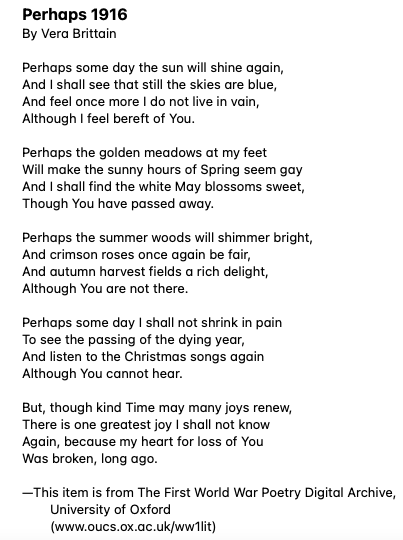
Brittain volunteered as a nurse for the Voluntary Aid Detachment – a unit of civilians providing nursing care during the First World War. She lost both her fiancé and her brother in the war.
Some well-known war poets who wrote about their experiences during World War I include Wilfred Owen, Siegfried Sassoon, Rupert Brooke, and Robert Graves. These poets, in particular, are associated with the “war poetry” movement of the early 20th century, characterized by its stark realism and anti-war sentiments. War poetry continues to be a significant genre, and poets throughout history and across cultures have explored the theme of war in their work.
My country is currently at war. In its seventy-five years, it has been at war many times. The current war was sparked by a horrific tragedy that befell us on October 7. We don’t know when this one will end. Every family we know has at least one loved one in it – a spouse, a child, a grandchild. A friendly young woman my wife has come to know at a local store has a husband, a daughter, and a son, all serving simultaneously. One of my country’s great poets, the late Yehuda Amichai (1924-2000), knew war and wrote poems about it. Here is one from the book The Poetry of Yehuda Amichai. [edited by Robert Alter]. Chana Bloch translated the poem.
20
The diameter of the bomb was thirty centimeters
and the diameter of its effective range about seven meters,
with four dead and eleven wounded.
And around these, in a larger circle
of pain and time, two hospitals are scattered
and one graveyard. But the young woman
who was buried in the city she came from,
at a distance of more than a hundred kilometers,
enlarges the circle considerably,
and the solitary man mourning her death
at the distant shores of a country far across the sea
includes the entire world in the circle.
And I won’t even mention the howl of orphans
that reaches up to the throne of God and
beyond, making
a circle with no end and no God.
– Amichai, Yehuda. The Poetry of Yehuda Amichai (The Copenhagen Trilogy) (p. 245). Farrar, Straus and Giroux. Kindle Edition.
When I take my dog out for daily walks, he still lingers over late-night scents and stands with his nose quivering, smelling the breeze. The morning air is cool. And sometimes, if I close my eyes, I can imagine standing again on a pier in St. Andrews, hearing waves and the sound of gulls. It’s the beginning of the rainy season here. I open my eyes and look at the sky. Clouds stretch across it, and the sun plays a glorious hide-and-seek game. I hear what sounds like thunder. But it’s not. It’s the sound of warplanes. I look at my dog and wonder, in his world, what he truly feels, sees, senses, and smells.
May peace, real peace, abiding peace come soon to all.
All the best,
Gershon

 Gershon Ben-Avraham
As you may know, Wilfred Owen and Siegfried Sassoon met at Craiglockart in Edinburgh, which was then a hospital for shell shocked soldiers and is now part of Napier University. The University still holds a collection about the war poets. You can read about it here: https://www.sconul.ac.uk/sites/default/files/documents/4_11.pdf
LikeLiked by 1 person
Indeed! Their meeting is an amazing story. Thanks for the link.
LikeLiked by 1 person