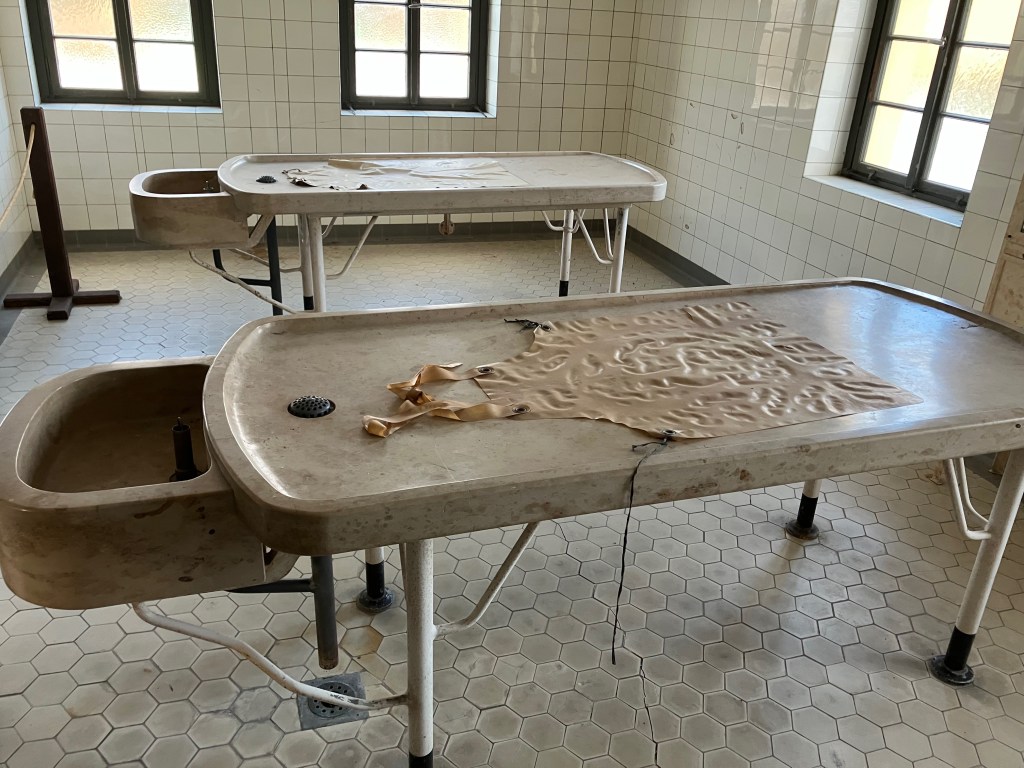
Specifically, the Examination/Washing Room. Photo by Gershon Ben-Avraham
Note: Terezín refers to the Czech town and fortress built in the late eighteenth century. Theresienstadt refers to the Nazi ghetto and transit camp established there during World War II. In what follows, I use Terezín for the town/fortress and Theresienstadt for the wartime camp.
Terezín lies about 38 miles (61 km) northwest of Prague. Our guide, Michaela, and a driver collected us from our hotel in the early morning in the Old Jewish Quarter of Prague. We crossed the Vltava River and joined the highway toward Litoměřice, passing farmland and villages little changed in centuries.
Before entering Terezín, we saw a fortress off to our right. Visitors sometimes mistake it for the camp itself, but it is the Small Fortress (Malá pevnost). Built in the late eighteenth century as part of the Habsburg defense system, it later became a military prison. Under Nazi occupation, the Gestapo used it as a detention center. About 32,000 people—including resistance fighters, political prisoners, POWs, and roughly 5,000 women—were held there. Around 2,600 died from torture, hunger, or disease; more than 250 were executed on-site; and many others were deported to concentration camps, where most perished. The last executions took place on May 2, 1945, just days before liberation. Though separate from the ghetto, the Small Fortress was an integral part of the machinery of imprisonment.
The town of Terezín itself was built in the 1780s on the orders of Emperor Joseph II, named after his mother, Maria Theresa. Designed as a fortress to protect against Prussia, its geometric plan featured bastions, flood defenses, and a garrison town inside. It was a living military system rather than a civilian town. But the fortress never fought the battle for which it was designed. By the nineteenth century, its walls had lost value, and Terezín settled into life as a barracks town where soldiers and families lived in relative routine.
In 1941, the Nazis transformed Theresienstadt into a Jewish ghetto and transit camp. Its walls and location near Prague made it ideal for confinement. Jews from Bohemia, Moravia, Germany, Austria, the Netherlands, Denmark, and other places were deported here. The Nazis staged it as a “model camp,” showcasing schools, gardens, and concerts for propaganda films and even a Red Cross inspection. In reality, conditions were dire—overcrowded, diseased, and starved.
Between 140,000 and 155,000 Jews passed through Theresienstadt. About 33,000 died there from hunger and illness, while 88,000 were deported to extermination camps such as Auschwitz. Only around 17,000–19,000 remained alive when the Red Army liberated Theresienstadt in May 1945.
Despite the horrors, cultural and spiritual life persisted. Inmates staged plays and concerts, children created art, and clandestine prayer rooms were established. One secret synagogue, hidden in a private house, had Hebrew texts painted on its walls and remained undiscovered by the guards.
We visited the Ghetto Museum, which displays many artifacts that bring to life the cultural vibrancy of the ghetto. Children’s artwork—collages, drawings, and dreamlike illustrations—line the stairways and walls. They reveal both imaginative escapes into fantasy and the stark realities of life in Theresienstadt.
Among the most remarkable cultural figures was Rafael Schächter, a young Czech conductor who formed a choir inside Theresienstadt. With only a single copy of Verdi’s Requiem, he taught singers by memory and staged performances that gave prisoners strength and symbolized defiance. In October 1944, Schächter was deported to Auschwitz and died during the forced death march from the camp in 1945.
When Soviet forces arrived on May 9, 1945, they found thousands of inmates, many weak and ill. Typhus spread rapidly, leading to quarantine. Relief workers struggled to save lives. After the war, Terezín’s fortress and Theresienstadt’s ghetto buildings were used again as prisons, this time for Germans and collaborators during the postwar expulsions and retributions. The site of Jewish suffering became briefly a place of punishment for others.
Over time, Terezín returned to being a town. Families resettled, apartments were rebuilt, and daily life resumed inside the old walls. Today, about 2,500 people live there, balancing ordinary community life with the weight of memory.
During the communist period, Terezín was preserved as a memorial, but the story told was shaped by ideology. Exhibits emphasized antifascist resistance more than Jewish suffering, and preservation was limited. Only after 1989 was the Terezín Memorial fully established, caring for cemeteries, museums, the crematorium, the Small Fortress, and barracks. Its mission now includes historical research, education, and remembrance of Holocaust victims.
Our driver drove from Terezín the short distance to the Jewish cemetery and mortuary near Theresienstadt. Built around 1902 by the local community, the mortuary was originally used for taharah, the ritual washing and preparation of the dead. It had stone tables and drains to facilitate the burial society’s work. When the Nazis created the ghetto, they repurposed the building as an “examination room,” where corpses were measured, recorded, and inspected before burial or cremation. The cemetery was used until 1942, when mass deaths led to cremation. After the war, it became part of the memorial. Today, it is no longer a religious site, but a place of remembrance, honoring both its original and wartime roles.
The story of Terezín and Theresienstadt weaves together the design of fortresses, Nazi deception, cultural endurance, and layers of postwar history. Built as a stronghold, transformed into a ghetto, and later returned to a town, it now stands as both a living community and a solemn memorial, preserved for the future by the Terezín Memorial.
All the best,
Gershon

 Gershon Ben-Avraham