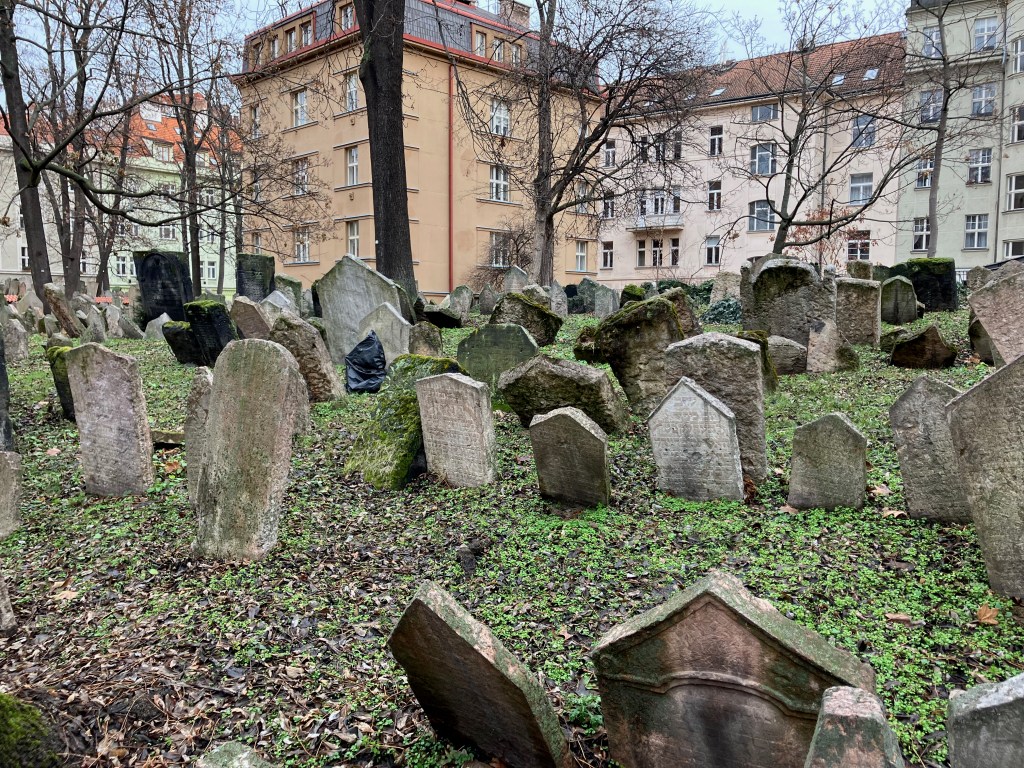
Photo by Gershon Ben-Avraham.
Cemeteries in Bohemia are like gardens. The graves are covered with grass and colourful flowers. Modest tombstones are lost in the greenery. When the sun goes down, the cemetery sparkles with tiny candles. It looks as though the dead are dancing at a children’s ball. Yes, a children’s ball, because the dead are as innocent as children. No matter how brutal life becomes, peace always reigns in the cemetery.
— Milan Kundera, The Unbearable Lightness of Being
There are from 80 to 84 cemeteries in Prague. Of them, there are nine identified as Jewish. In this blog, I want to write about three of the Jewish cemeteries: The Old Jewish Cemetery in Žižkov, The Old Jewish Cemetery in Josefov, and The New Jewish Cemetery in Olšany.
Old Jewish Cemetery in Josefov (Starý židovský hřbitov v Josefově)
Location: Josefov (Jewish Quarter), Prague 1 – Address: Široká 3, 110 00 Staré Město
The Old Jewish Cemetery in Josefov, the heart of Prague’s historic Jewish Quarter, is one of the oldest Jewish burial grounds in Europe. It was established around 1439 and remained in active use until 1787, when burials were prohibited in city centers due to health reforms under Emperor Joseph II. Despite its modest surface area, the cemetery holds over 12,000 visible tombstones. It is believed to contain as many as 100,000 interred individuals, with graves layered up to ten deep due to space constraints.
Among the most significant figures buried here is Rabbi Judah Loew ben Bezalel, known as the Maharal of Prague (c. 1525–1609). A Talmudic scholar, philosopher, and mystic, the Maharal is famed for his rationalist commentaries and for the enduring legend that he created the Golem of Prague—a mystical clay figure brought to life to protect the Jewish community. His gravestone remains a focal point of pilgrimage for Jewish visitors worldwide.
During the Nazi Protectorate (1939–1945), the cemetery was paradoxically preserved by the Nazis, who intended it to become part of a grotesque “Museum of an Extinct Race” after the extermination of European Jewry. Artifacts and tombstones were cataloged rather than destroyed, resulting in the cemetery’s survival. Under Communist rule (1948–1989), the site became part of the state-controlled Jewish Museum, which was stripped of religious function and administered through an atheistic lens. Restoration was minimal, and access was limited to historical interest rather than spiritual connection.
Today, the cemetery is a protected national cultural monument and a central component of the Jewish Museum in Prague.
Old Jewish Cemetery in Žižkov (Starý židovský hřbitov v Žižkově)
Location: Žižkov, Prague 3 – Address: Fibichova 2, 130 00 Praha 3
This lesser-known cemetery was established in 1680 during a devastating plague epidemic, when existing cemeteries could no longer accommodate the dead. Located in the then-outlying district of Žižkov, it served the Prague Jewish community until it was closed in 1890 after the opening of the New Jewish Cemetery in Olšany. Despite its historical importance, it remained overshadowed by the more centrally located Josefov cemetery.
The most eminent person buried here is Rabbi Ezekiel Landau (1713–1793), also known by the title of his major halachic work, the Noda B’Yehuda. A preeminent authority in Jewish law and chief rabbi of Prague, Landau was deeply respected across Europe for his judicious, pragmatic responsa. His grave became a revered site, particularly for rabbinic scholars and Hasidic Jews, somewhat paradoxically given Landau’s ardent opposition to Hasidism, who visit to pay respects.
When the Nazis occupied the area, the Žižkov cemetery was mostly ignored and fell apart. It wasn’t torn down on purpose, but many of the gravestones were broken, taken, or reused for building materials. The cemetery was kind of out of the way, which probably helped it avoid being completely destroyed. Still, the Nazis had no respect for Jewish history, and it shows.
During the Communist era, the site suffered from further neglect, as state policy discouraged preservation of religious spaces, particularly those not centrally featured in the museum circuit. Parts of the cemetery’s land were encroached upon by housing and infrastructure projects, and public access was limited.
Rabbi Shnayer Leiman, my wife’s cousin and a noted scholar, sent us the following note about a story he had shared with our Czech tour guide, Michaela, concerning his own family’s connection to the grave of the Noda B’Yehudah.
During the Communist period, my parents visited Prague (in the late 1950s) on the way to a visit to Israel. My father told me that the shammos of the Alt-Neu Shul accompanied him to the Noda Bi-Yehudah’s grave, which was marked by a very large tombstone.
I visited Prague a few years later (in 1960), still under Communist rule, and the same shammos pointed to the very large tombstone and told me that it marked the Noda Bi-Yehudah’s grave. He said that it was dangerous for him to be seen with me, and he pointed from afar to the large tombstone and quickly left the cemetery grounds.
At that time, the cemetery was in total disarray, with garbage strewn everywhere. I spent hours in the cemetery, reading as many tombstones as possible. When I got to the large tombstone and read it, it clearly was not the grave of the Noda Bi-Yehudah. It mentioned his name, but it was an official apology by the Jews of Prague for not making a large tombstone for the Noda Bi-Yehudah. He had left orders that he wanted a small tombstone with no praises of him on it.
I then searched everywhere for his tombstone, but it was nowhere to be found. Eventually, I cleared some dirt on the ground, near his wife’s tombstone, and found little pieces of tombstone sherds, put them together, and lo and behold—it was the Noda Bi-Yehudah’s tombstone, in smithereens.
I alerted the authorities, and later in the U.S., notified some descendants of the Noda Bi-Yehudah about the matter. No one did a thing. Apparently, under Communist rule, nothing could be done.
I went back several times before the Velvet Revolution, and nothing was ever done. In 1990 or so, I mentioned the problem to a friend, who said, “Why don’t you call Jerry Weiss?” Jerry Weiss was a wealthy Judaica book collector, and I knew him well. The friend then explained that Jerry Weiss was a direct descendant of the Noda Bi-Yehudah!
I immediately telephoned Jerry and told him how I have never stopped calling descendants of the Noda Bi-Yehudah about the problem. He stopped me in the middle of telling the story and said: “Dear friend, please tell no one else. I want this mitzvah for myself!“
The rest is history. He flew to Prague, and he cleaned up the entire cemetery (what was left after the Communists destroyed more than half [of] it), paved pathways, built a new wall around the cemetery, and used all the pieces of the original tombstone to create an exact replica that was placed over the original grave for all to see.
That’s the story, and it’s amazing that Michaela remembered that there was a story.
Since the 1990s, post-Communist restoration efforts have sought to preserve and protect the cemetery. Although not regularly open to the public, the site is now recognized as a historical monument, and the grave of Noda B’Yehuda is marked and maintained. The cemetery is periodically visited by religious pilgrims and historians who understand its significance in Central European Jewish scholarship.
New Jewish Cemetery in Olšany (Nový židovský hřbitov v Olšanech)
Location: Strašnice, Prague 3 – Address: Izraelská 1, 130 00 Praha 3
Opened in 1890 to replace the exhausted Žižkov cemetery, the New Jewish Cemetery in Olšany remains an active burial ground and one of the most serene Jewish spaces in the city. It was designed with greater space and modern needs in mind, featuring wide pathways, family plots, and ornate tombs. The cemetery today houses over 25,000 graves and has space for up to 100,000 burials.
Its most internationally famous resident is Franz Kafka (1883–1924), the seminal writer of German-language fiction whose nightmarish, existential themes continue to resonate globally. Born in Prague, Kafka died in Austria from tuberculosis at age 40. He was buried here with his parents, and his grave—marked by a simple granite obelisk—is now a literary pilgrimage site. Though Kafka was secular and distanced from Jewish orthodoxy, his identity as a Jew remains central to many interpretations of his work. There are more details about Kafka and his grave in the first blog in this series on Prague: Prague 1: Kafka—“I Kicked Him in the Belly”.
Unlike the other cemeteries, the Olšany site remained operational during the Nazi period, though the Jewish community was devastated by deportations beginning in 1941. The cemetery itself was not targeted for destruction, and Kafka’s grave was not desecrated, likely due to his growing reputation abroad. Under Communism, the cemetery continued to accept Jewish burials, but maintenance was sporadic. Kafka’s grave attracted underground admiration from writers, intellectuals, and foreign visitors, despite official discouragement of Western cultural icons.
Today, the cemetery is well-maintained and open to the public. In addition to Kafka, I provided details on Kafka’s grave in the first blog of this series. it includes the graves of many Czech Jewish artists, rabbis, and political figures. It is one of the few Jewish cemeteries in Europe that has remained continuously active for over a century. Visitors can walk shaded paths, discover art nouveau gravestones, and reflect quietly at Kafka’s resting place—a striking contrast to the historical turbulence endured by Prague’s Jewish community.
I found these cemeteries a fascinating chronicle of a part of Jewish history inside today’s Prague, echoes of eternity.
All the best,
Gershon

 Gershon Ben-Avraham