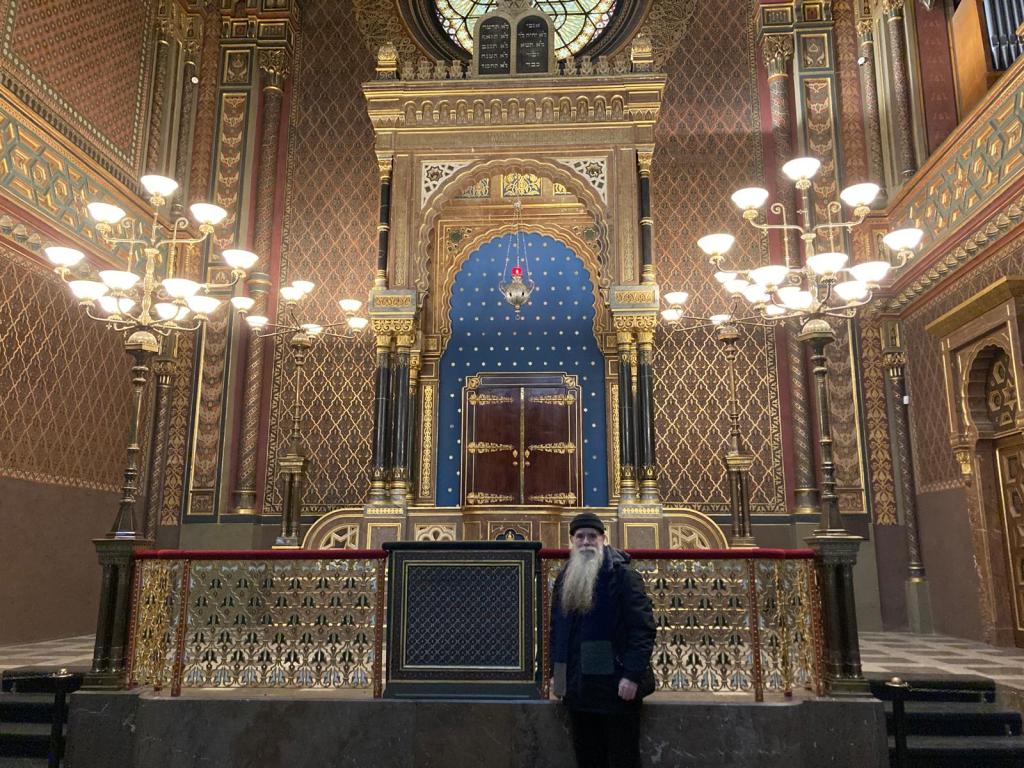
Photo by Beth Ben-Avraham, 2025.
In his book, The Sabbath, the Jewish religious philosopher Abraham Joshua Heschel (1907-1972) writes:
Judaism teaches us to be attached to holiness in time, to be attached to sacred events, to learn how to consecrate sanctuaries that emerge from the magnificent stream of a year. The Sabbaths are our great cathedrals; and our Holy of Holies is a shrine that neither the Romans nor the Germans were able to burn; a shrine that even apostasy cannot easily obliterate: the Day of Atonement. According to the ancient rabbis, it is not the observance of the Day of Atonement, but the Day itself, the “essence of the Day,” which, with man’s repentance, atones for the sins of man.
Heschel, Abraham Joshua. The Sabbath (FSG Classics) (pp. 17-18). Kindle Edition.
This is a powerful statement from Heschel concerning the enduring sanctity of sanctuaries in time in contradistinction to sanctuaries in space. Sanctuaries in time are immune to physical destruction. Catastrophe does not touch them. Even apostasy, spiritual betrayal, or loss of belief leaves them untouched. Heschel’s prime example is the Day of Atonement.
Yet, of course, the Jews have had, and continue to have, sanctuaries in space, places where they gather to pray or study, to celebrate or mourn together. In this blog, I want to focus on three Jewish sanctuaries, sanctuaries in space, in Prague, a city renowned for its rich Jewish history. The three are the Old-New Synagogue, the Pinkas Synagogue, and the Spanish Synagogue.
The Old-New Synagogue (Altneuschul) and the Legend of the Golem
Old‑New Synagogue – Staronová synagoga (Maiselova 18, 110 01 Josefov, Prague. Completed around 1270, it was built by the Jewish community of Prague and holds the distinction of being the oldest active Gothic synagogue in Europe. Originally named the “New” or “Great” Shul, its name reflects a distinguishing history: originally “New” compared to an even older synagogue, it later became the “Old‑New” once more synagogues were erected. Architecturally, it features pointed ribbed vaults, twin naves typical of early Gothic structures, and a wrought-iron grille around the bimah. A notable relic is the chair of Rabbi Judah Loew ben Bezalel, also known as the Maharal (1512–1609), renowned for his mystical teachings. The congregation has been Orthodox since its foundation and is administered by the Prague Jewish Community. It underwent several restorations—most recently in 1998–99—and is protected as a National Cultural Monument.
Among the legends surrounding the Old‑New Synagogue is the tale that Rabbi Loew’s Golem, a man-like creature made of clay, lies dormant in its attic genizah. Some versions claim that synagogue renovations in 1883, and modern investigations have found no trace of the creature. Others add sensational elements, such as Nazi agents entering the attic and perishing, but none are verified. The attic staircase was removed to restrict access, and it remains closed to the public.
A story of Rabbi Shlomo Carlebach’s visit to the Old-New Synagogue in the late 1960s is recounted in the book Holy Brother by Yitta Halberstam Mandelbaum, published by Aronson in 1997. Rabbi Carlebach was with a tour group that had been assigned a rather doctrinaire Communist guide who frequently mocked the Jewish sites the group visited, denigrating their holiness. At the Old-New Synagogue, the tour guide made fun of Jews who believe the story of the Golem, stating, “Fools actually believe the so-called Golem’s bones are supposedly buried in the attic. There are so many idiots in this world, people are actually afraid to go up to the attic; they think something terrible will happen to them.” Rabbi Carlebach finally had had enough. “His patience finally gone, Shlomo quietly stepped up to the tour guide, and asked, ‘Could you please take us up to the attic?'” The guide demurred, claiming that such a visit was not part of the program. But Rabbi Carlebach persisted. “‘Look,’ said Shlomo pulling out his checkbook. ‘I’ll give you $200 (in the ’60s quite a princely sum) to take us up to the attic now. Surely you can use the money?’ Angrily, the man shook his fist at Shlomo, and wide-eyed with fear, grabbed his coat, looked over his shoulder, and fled.” (Holy Brother, pp. 59-60.)
The Pinkas Synagogue as a Holocaust Memorial and Its Poignant Inscriptions
Pinkas Synagogue – Pinkasova synagoga (Široká 3, 110 00 Josefov, Prague. The Pinkas Synagogue was built in 1535 by Aaron Meshullam Horowitz and was likely named after his grandson, Rabbi Pinkas Horowitz. Designed in late Gothic style with early Renaissance annexes, its significant features include a ceiling decorated with a web of intersecting stone ribs, a carved stone Holy Ark, and an ornate Rococo wrought-iron bimah grille donated in 1793. The Jewish Museum in Prague maintains it. Between 1950 and 1954, it was restored and then converted into one of Europe’s earliest Holocaust memorials (1955–60), now lined with nearly 80,000 names of Czech victims. It also houses children’s drawings from Terezín. After closures during the Communist rule, it reopened in 1995 and continues to serve as a memorial and museum venue. I took the following short video on a recent visit to the synagogue.
The Spanish Synagogue’s Architecture, History, and Reform Traditions (Including the Use of an Organ)
Spanish Synagogue – Španělská synagoga (Dušní 12 / Vězeňská 1, 110 00 Josefov, Prague). The Spanish Synagogue was completed in 1868 on the site of the medieval Altschul (“Old School”) and built for Prague’s Reform community. It was designed by Josef Niklas and Vojtěch Ignác Ullmann in Moorish Revival style, with interior decoration by Antonín Baum and Bedřich Münzberger. The synagogue is notable for its central dome, low-stucco arabesques inspired by the Alhambra, stained glass featuring the Star of David, and the placement of the bimah along the eastern wall—the latter reflecting Reform liturgy. Composer František Škroup, author of the Czech national anthem, served as organist at the earlier Old Shul here from 1836 to 1845. Now managed by the Jewish Museum since 1955, it was restored in 1958–59, closed for safety in 1982, and renovated and reopened in 1998. Today, it hosts historical exhibitions and concerts. The picture at the top of this post shows the interior of the Spanish Synagogue.
Prague is a stunningly beautiful city. If you have an opportunity to visit the city, I highly recommend visiting these three magnificent synagogues.
All the best,
Gershon

 Gershon Ben-Avraham
The Spanish Synagogue was one of the highlights of my visit to Prague many years ago. Thank you for reviving that memory so vividly. Wishing you the best.
LikeLiked by 1 person