
Recently, my wife and I vacationed in the Czech Republic, also known as Czechia (CHEK-ee-uh). We stayed in Prague, the country’s capital, but we took two day trips, one to Terezin and the other to Kolin. It was my wife’s second trip to Prague. She first visited the city as a child with her parents in the summer of 1970. At that time, the country was called the Czechoslovak Socialist Republic. It was under communist rule, and its leader was Gustáv Husák.
She doesn’t remember much from that first visit. A notable exception is the Prague Orloj (Pražský orloj), which was installed in 1410 and is one of the oldest working astronomical clocks in the world. The clock is mounted on the Old Town Hall in Old Town Square. I will have more to say about it in a later blog. It was my first visit, and I have to confess that I was smitten by the city’s beauty, history, and charm.
This is the first of eight blogs I plan on various aspects of our visit to Czechia. I am Jewish, so some of the blogs naturally reflect items of particular Jewish interest, such as finding kosher food and davening on Shabbos. Others are not. My plan is to create and post the blogs in the following sequence:
- Kafka
- Kosher eating in Prague
- Synagogues of Prague
- Prague’s Jewish Cemeteries
- Terezin
- Kolin
- The Vltava (with the artificial island)
- Prague’s Old Town – Time and Memory
This first blog is about some items concerning Franz Kafka.
Kafka
Visits to two Kafka sculptures: Jaroslav Róna’s Kafka and David Černý’s Kafka Head. The visit to Kafka’s grave at the New Jewish Cemetery. Reflection on the tragic fate of Kafka’s three sisters during the Holocaust.
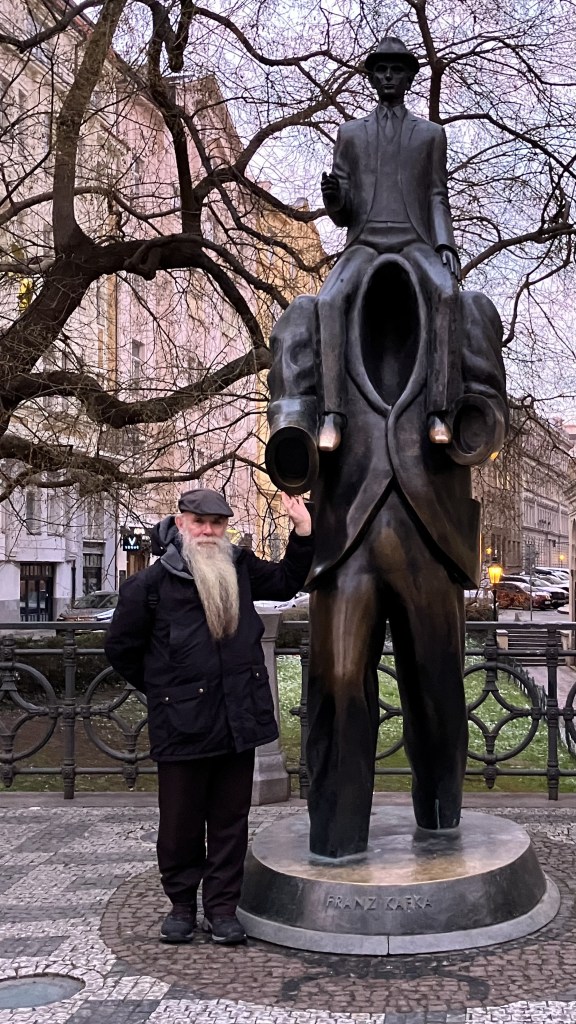
We visited two very different outdoor sculptures of Franz Kafka in Prague, the city where he was born and lived. The first one is by artist Jaroslav Róna. It is located in Prague’s Jewish Quarter (Josefov), at Dušní Street, near the Spanish Synagogue. It depicts Franz Kafka riding on the shoulders of a headless figure. The sculpture was inspired by Kafka’s 1912 story “Description of a Struggle” (Beschreibung eines Kampfes).
And now—with a flourish, as though it were not the first time—I leapt onto the shoulders of my acquaintance, and by digging my fists into his back I urged him into a trot. But since he stumped forward rather reluctantly and sometimes even stopped, I kicked him in the belly several times with my boots, to make him more lively. It worked and we came fast enough into the interior of a vast but as yet unfinished landscape.
Kafka, Franz. The Complete Stories (The Schocken Kafka Library) (pp. 20-21). (Function). Kindle Edition.
Well, the story is an early one but already reflects Kafka’s uniqueness. The sculptor, I believe, has captured that Kafkaesque peculiarity in his sculpture.
In the center of Prague, a large outdoor sculpture of Franz Kafka’s head stands near Národní třída. The artwork, called K on Sun, was created by Czech artist David Černý. It is made of 42 stainless steel layers that rotate independently.
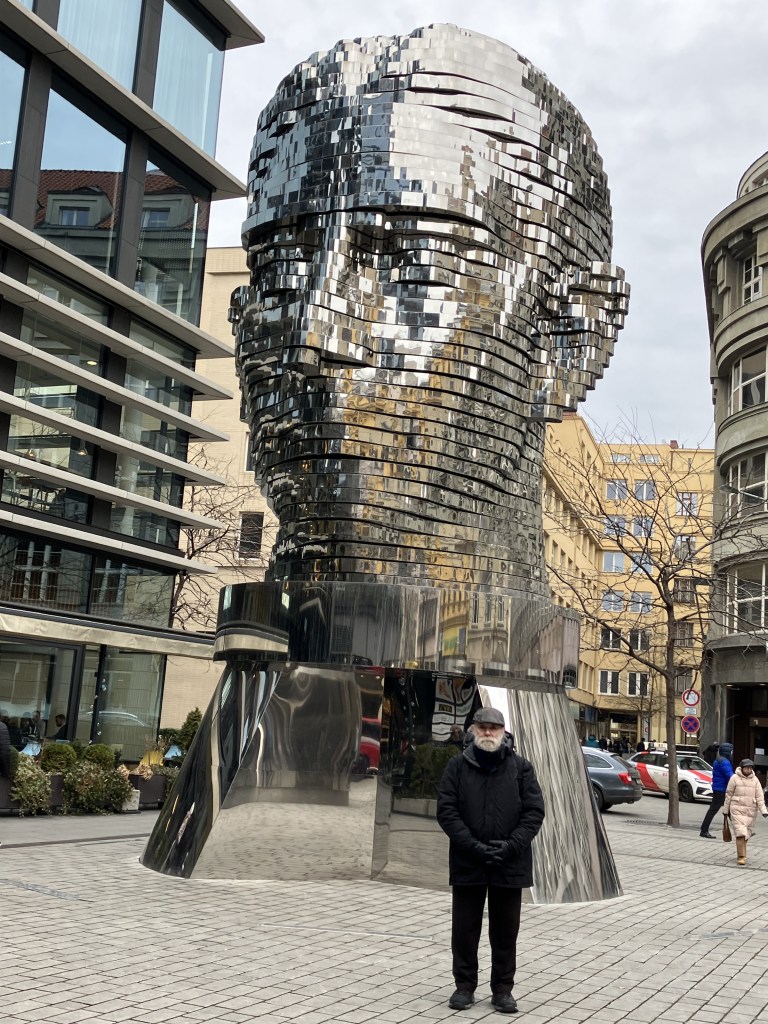
The sculpture was placed here because Kafka once worked nearby in an insurance office. The location connects the artwork to his life and legacy in the city.
The head is 11 meters tall and weighs 39 tons. What makes it unique is its movement. Each layer shifts, creating a fragmented, shifting form. The pieces slowly rotate and, at times, align to form Kafka’s face. This full alignment happens about every 15 minutes.
The moving layers reflect themes from Kafka’s writing, such as identity and transformation. The sculpture is also a symbol of Prague itself—modern, historic, and always changing. My wife and I stopped to watch the head turn, capturing its hypnotic motion in some photos, one of which is shown above.
The last Kafka site my wife and I visited was Franz Kafka’s grave. It is in the New Jewish Cemetery, a quiet place with rows of old tombstones and shaded paths. Kafka, who died in 1924 at the age of 40, is buried alongside his parents, Hermann and Julie Kafka. I often visit the graves of famous writers. In Paris, I went to see Oscar Wilde’s tomb in Père Lachaise, for example. And in Vermont, I visited Robert Frost’s grave. Kafka’s resting place, though, felt different. I’ll say something about that later.

At the cemetery entrance, a sign points the way to “Dr. Franz Kafka.” [See photo at the top of the blog.] The title surprised me, but it’s accurate. Kafka studied law and earned a doctorate, though he worked in insurance for most of his life. His true passion, we know, was writing, but much of his work remained unpublished while he was alive.
Kafka died in a sanatorium in Austria. He had tuberculosis, a disease that slowly robbed him of his voice and strength. In his final days, he was unable to eat because of throat pain. He passed away in June 1924. His body was brought back to Prague for burial.
The grave itself is modest—just a simple stone with his name and dates. Small stones, a Jewish tradition of remembrance, rest on the surface. But one thing sets this grave apart from others I have visited – a memorial plaque on the ground in front of the grave that lists three people not buried there or anywhere we know of: his three sisters, Gabriele, Valerie, and Ottilie. Kafka’s sisters did not die of an illness or old age; they perished in the Holocaust.
Certainly, Kafka’s death was tragic, but it was natural. His sisters’ deaths, on the other hand, were acts of violence, part of a horror beyond imagination. Their names turn a writer’s grave into something more—a reminder of loss, history, and memory.
All the best,
Gershon

 Gershon Ben-Avraham